
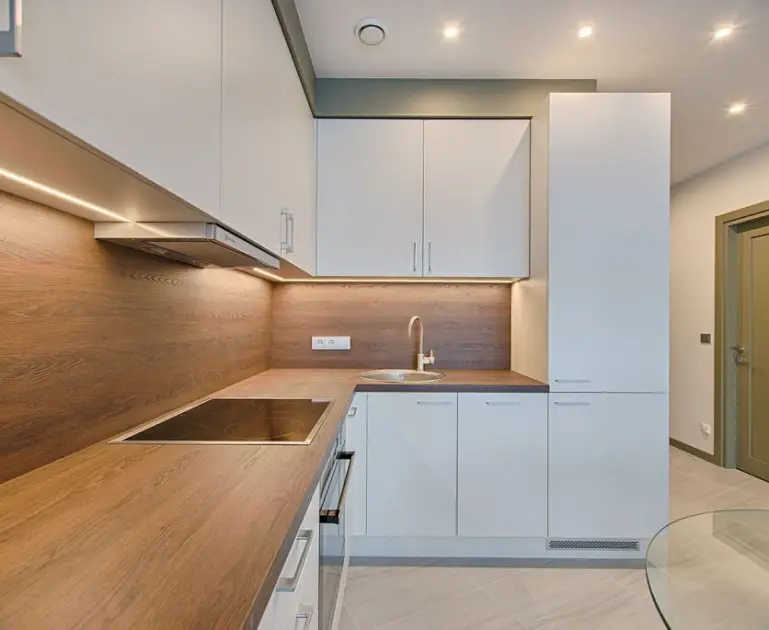
Average Budget Tiers
Most Melbourne kitchen projects sit in one of three tiers, but the tier only means something when you define what is changing.
- Refresh ($15k-$25k): Keep the same footprint, improve doors, hardware, benchtops, splashback, tapware and paint. Best suited to homes where storage and workflow already work.
- Mid-range rebuild ($30k-$55k): Full strip-out, new cabinetry, new stone, better lighting, updated appliances and moderate service movement. This is the most common owner-occupier project.
- Premium or structural ($60k-$110k+): Walls removed, steel added, custom joinery, premium appliances, large porcelain or stone detailing and a broader open-plan redesign.
The jump between tiers is rarely caused by one premium item alone. It is usually driven by stacked complexity: moving drainage, redesigning circulation, reworking ceilings, upgrading switchboards or choosing custom fabrication across multiple surfaces.
Quick Scenario Comparison Table
| Scenario | Likely Spend | Usually Included | Main Budget Risk |
|---|---|---|---|
| Keep layout, upgrade finishes | $15k-$30k | Doors, tops, splashback, lighting improvements, appliance swaps | Under-allowed joinery upgrades and electrical extras |
| Full rebuild in same footprint | $30k-$55k | New cabinetry, new tops, service updates, better storage, full fit-off | Old-home service issues and owner upgrades mid-build |
| Open-plan structural redesign | $60k-$110k+ | Wall removal, structural work, flooring continuity, custom joinery, premium appliances | Engineering, approvals and scope expansion |
The table matters because homeowners often compare quotes from different scenarios as if they are pricing the same room. They usually are not.
What Usually Moves the Price Fastest
The biggest budget swings usually come from changes that affect more than one trade. For example, relocating a sink often means joinery redesign, plumbing alteration, benchtop cut-out changes and sometimes flooring or patching work.
- Layout changes: New service locations almost always cost more than homeowners expect.
- Joinery complexity: Tall pantries, appliance towers, integrated bins and custom internals add labour and hardware, not just board area.
- Appliance strategy: Fully integrated fridges, induction upgrades and premium rangehoods pull electrical and cabinetry scope upward.
- Finish continuity: Waterfalls, full-height splashbacks, feature lighting and panel-ready appliances all increase coordination time.
If you are trying to control budget, decide early whether your kitchen needs a new layout or just a better version of the current one. That decision shapes the rest of the cost plan.
Cabinetry, Benchtops and Finish Allowances
Cabinetry is still the largest single line item in most kitchens, often taking 30% to 45% of total project spend. The difference between a basic joinery package and a high-function package can be several thousand dollars even before benchtops are templated.
- Mid-tier custom cabinetry: Often lands around $9k-$25k depending on room size, internals and finish system.
- Engineered stone or porcelain tops: Commonly $2,500-$6,500 before waterfalls, drainer grooves or complex joins.
- 40mm built-up edges and waterfall ends: Improve presence, but can add meaningful fabrication cost quickly.
- Handles, pull-outs and internal storage: Small upgrades on paper, but expensive when repeated across the whole room.
A common quoting problem is unrealistic allowances. If the quote allows for budget laminate internals and off-the-shelf handles, but the homeowner expects shark-nose profiles, pull-out pantry hardware and full-height cabinetry, the contract price will not reflect the real build.
Trades, Services and Compliance Costs
Kitchens are not expensive just because of materials. They are expensive because a lot of skilled work has to happen in sequence, and older Melbourne homes often need service upgrades once walls are opened.
- Demolition and disposal: Usually around $800-$2,000 depending on access and waste volume.
- Plumbing rough-in and fit-off: Often $1,800-$3,500, higher if gas lines, drains or fridge points are added.
- Electrical and lighting: Often $1,600-$3,500, with switchboard upgrades or new dedicated appliance circuits increasing cost.
- Tiling, splashback and patching: Wide range depending on tile format, surface prep and finish level.
Do not ignore compliance and rectification items. Gas work, older wiring, uneven walls and substandard existing plumbing can all create mid-build costs that do not appear in an aspirational showroom estimate.
Hidden Costs That Blow Up Cheap Quotes
The most dangerous quotes are not the highest ones. They are the ones that appear low because multiple necessary items are excluded, assumed or buried in vague provisional sums.
- Skip bins, waste handling and protection of adjacent floors
- Stone templating delays and return visits for final install
- Switchboard or circuit upgrades in older homes
- Structural engineer input if walls are altered
- Painting, cornice repairs and patching after cabinetry removal
- Temporary cooking setup and the practical cost of living without a full kitchen
When comparing quotes, ask a direct question: which items are excluded, provisional or owner-supplied? That usually reveals whether a low number is genuinely efficient or simply incomplete.
Example Budget Logic for Real Homes
A family home keeping the same layout may spend more on storage, lighting and durable surfaces because those upgrades improve daily use without triggering structural or plumbing cost. By contrast, a home opening the kitchen to living areas may spend much more on steel, flooring continuity, plaster repairs and reworked services even before premium appliances are considered.
The practical lesson is simple: decide whether you are paying for a better room or a different room. A better room can often be delivered inside a controlled budget. A different room needs contingency, clearer design documentation and less optimism about variations.
How to Control Spend Without Building Regret
Good cost control does not mean choosing the cheapest finish in every category. It means being selective about where design ambition actually improves function.
- Lock appliances before joinery drawings are finalised.
- Use realistic allowances for tapware, lighting and handles.
- Freeze layout early unless the functional gain clearly justifies the extra cost.
- Spend on drawers, task lighting and ventilation before decorative upgrades.
- Keep a contingency for hidden site conditions even on simple projects.
A kitchen quote becomes far more reliable once the layout, appliance list and finish direction are all defined before contract signing.
Key Takeaways
- Kitchen budgets move fastest when layout changes affect multiple trades at once
- Cabinetry, benchtops and appliances only tell part of the story because service upgrades matter too
- Cheap quotes often rely on excluded items, vague provisional sums or unrealistic finish allowances
- The clearest cost-control move is deciding early whether the room needs redesign or just improvement
- Function-led upgrades like storage, lighting and ventilation usually outperform cosmetic-only spend
Questions Homeowners Usually Ask Next
How much should I budget for a kitchen renovation in Melbourne?
Budget depends on layout changes, cabinetry level, benchtop choice, appliance scope and trade complexity. As a rule, fixed-layout refreshes sit much lower than structural redesigns with new services and premium finishes.
Should I keep the same kitchen layout to control cost?
Usually yes. Retaining the sink, cooktop and major service points helps contain demolition, plumbing and electrical costs. Layout changes only make sense when workflow, storage or family use will materially improve.
What kitchen upgrades usually add the most practical value?
Better drawer storage, smarter appliance placement, durable benchtops, layered task lighting and a well-sized rangehood tend to improve daily use more than cosmetic-only upgrades.
How long does a kitchen renovation usually take?
Most kitchens run over several weeks rather than a few days, especially when cabinetry manufacturing, stone templating and multiple trade visits are involved. Lead times often matter more than the demolition phase.
Use This Article With Related Reading
Connect this advice to the delivery page that matches the renovation scope.
Read adjacent guides in the same decision stage to avoid thin, one-page planning.
Pair planning content with finished renovation visuals before locking scope and finishes.
Ready to Start?
If you want pricing that reflects your actual layout, appliance list and finish level instead of a padded allowance sheet, we can map it properly. Request an itemised kitchen renovation quote.